Tuesday, October 27, 2009

Famous Dependent Personality Disorder People

Project Cars: Technical Advances


the past twenty years, Pixar Animation Studios has become the vanguard of computer animation and continue taking advantage of almost unlimited technical resources to create new stories and characters that delight the public. From his first Oscar ®-winners and nominees from films to feature the first CG (computer generated images), "Toy Story, Pixar has never rested on its laurels. Each film has been a new challenge. In "A Bug's Life" (Bugs) were the blades of grass and the crowd scenes in "Toy Story 2" caricatured but realistic humans in "Monsters, Inc." (Monsters, Inc.). furry characters and simulated clothing, in "Finding Nemo" the brilliant underwater world, and "The Incredibles" (The Incredibles) filled environments action. His latest film, "CARS", stated one of the biggest challenges to date.

Under the supervision of associate producer Tom Porter, supervising technical director Eben Ostby, and the usual group of technical wizards at Pixar "CARS" started many revolutions and achieved some major milestones on the road.

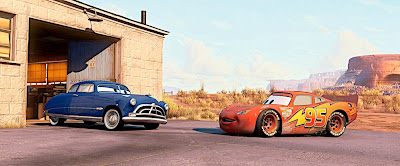
Perhaps the biggest challenge of the technical team "CARS" was created and painted metal surfaces of the characters in the cars and the reflections that generate these surfaces. At Pixar, we used first algorithmic technique called "ray tracing" for filmmakers had the desired effect.
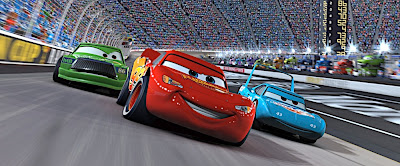


As Ostby says: "Data that our movie stars are made of goal, John wanted them to have more realistic reflections and lighting all of our previous films. In the past, we used mostly environment maps and other technology to recreate reflexes mate, but 'CARS' add a new 'ray tracing' (ray tracing) to put the bar even higher Pixar. "

The 'ray tracing' has existed for many years, but it was the rendering of Pixar team that introduced in almost all levels of "CARS." The head of rendering Jessica McMackin handled the film's final images, while optimizing the rendering manager Tony Apodaca had to minimize rendering time.

McMackin said: "In addition to creating accurate reflections, we use the 'ray tracing' to achieve other effects. We could use two shades to create very sharp, as when there are multiple light sources and want to create a casting shadows on the sides. Or occlusion, which is the absence of ambient light between two surfaces as a wrinkle in a shirt. A fourth use is irradiation. An example would be when you hold a piece of red paper against a white wall. The role of light and color projected a red glow on the wall. "
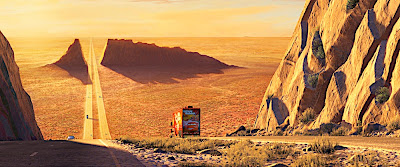


"Our computers are a thousand times faster than 'Toy Story'," says Apodaca, "but despite being much faster, our appetite is also increased and we like to test us. Because the 'ray tracing' and all the reflections, the average time to establish a frame of film 'Cars' was 17 hours. Some frames took us a week. In this movie, we have much larger images and more beautiful as a lighting and a 'ray tracing' much more subtle. "

Another major achievement the film is a ground anchoring system which ensures that the car is firmly attached to the road, except that the story requires an exception to this rule. Tim Milliron, the supervisor of characters, who led the group in charge of the models, assembly and shading of the characters, wrote the code for this program.

"The ground anchoring system is one of the things I'm most proud of this movie," says Milliron. "Before, the characters do not know your environment. Took a pass from simulation if we wanted something to happen. In 'CARS,' this system is created in their own models, and moving the car, the vehicle is stuck to the floor. It is something that usually happens in Pixar. We want to do something but at first we had no idea how to do it. "
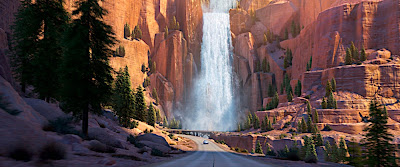


Another big milestone was the team of characters to give it a universal mount that works on all the characters. This means the same animation controls (or avars) can be applied to each and every one of nearly 100 unique car characters without creating new elements of joint. It fit the same basic chassis geometry of each car, but each car has a custom suspension.

"We created some 1,200 avars the animators were able to play" Milliron said. "Some characters, like the Mater with his crane, had more, of course. More than ever, the Avars are designed to work together. For example, there are four major avars for the mouth. There is a miser who moves his mouth to the left and right, which moves the peak of the mouth upward and downward, a moving jaw Avar, Avar and a moving mouth peak outward and inward ".

Milliron's group was also responsible for the mass of cars that are located on the steps in the sequence of opening and closing races. With 120,000 cars in the stands, and 2,000 more in the interior, we can say that is the greatest scene mass has been done at Pixar (far superior to the thousands of ants in "A Bug's Life" [Bugs]). To further complicate the situation, all these vehicles have some form of mass entertainment.
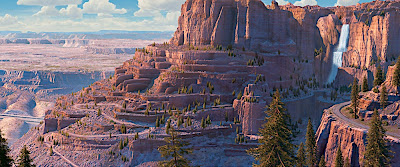


To reflect the excitement and anguish of the racing scenes in the film, Jeremy Lasky, the director of photography who was in charge of the camera and disposition, and his team went to a lot of races and talked with many film cameras often such events. Artie Kemper, veteran director of Fox Sports, a pioneer in the televising of racing, was a excellent source of information. According

Lasky: "Artie gave us valuable information on how placing their cameras on the track. He also talked about some plans that wanted to do. We could do a lot of things that were impossible for him. We could put a camera under the car, one in the middle of the track, riding a crane goes down and pass up the race for the cameras. Artie said he'd like us to have that kind of toys. The placement of the cameras 'CARS' we let the audience was in the midst of all the action. Put them in a world with which they are familiar and then flooded them with planes that had not ever seen. The film has spectacular moments in which the cars go to two millimeters of the camera lens, which is impossible in real action, and I do believe that was possible. "

Even in the most tranquil and serene setting of Radiator Springs, is also achieved some feats. One of the highlights and most complex of the tape is produced at the end of Act II, when the neon lights go on again because the city is alive with a caravan of cars crossing the main street. Because of its bright lights and shiny that originate in multiple sources and all reflections, this sequence was a of the most complex but also one of the most wonderful movie.
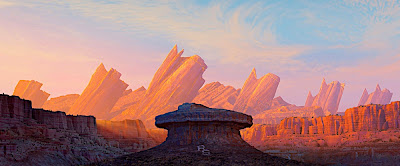


To enhance the richness and beauty of desert landscapes around Radiator Springs, the filmmakers created a department that was responsible for the matte paintings and extensions of heaven. Technical director Lisa Forsell and his team poured all their magic in this area.

"The digital matte paintings are a way to create a great visual complexity without having to build a very complex geometry and complicated drawing shaded" Forsell said. "We spent some time working in the clouds and their different formations. Often have multiple layers and moves in a corresponding manner. In fact, the clouds have some personality. The idea was that people think and see human forms in the clouds, cars see Car-shaped clouds. It's very subtle, but there are some that look much like a sedan. And if you look closely, you'll have some lines that look like the picture of the wheels.

"By paying so much attention to the clouds, reflects the film's visual level," he adds. "In the screen there is no pixel that is not carefully treated. It has left nothing to chance."
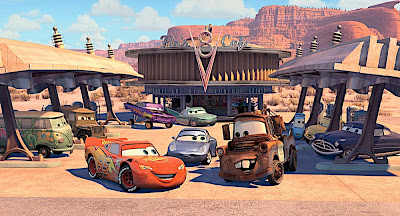


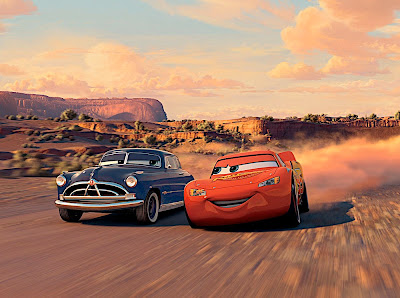
Steve May, the effects supervisor of "CARS" Applied the same care to nearly half the 2000 levels that make the film. Among the many effects that were created for the film were the trails of dust behind the car, the track of the tires, skid marks, water, smoke and drooling (from the front of Mater).

Source: Walt Disney Pictures and Pixar Animation Studios

Monday, October 26, 2009

Type Of Mucus One Week Before Periods

Cars: The Cars Key


"CARS" is dedicated to the legacy of the script of the late Joe Ranft, and the end credits of the film are a tribute to his enormous talent and his work. An extraordinary writer who lent his genius to create some of the stories and memorable characters of animated films over the past 25 years, Ranft was one of the best partners of all time in the field of motion picture association. From his days at Disney, where he helped to shape stories like "Who Framed Roger Rabbit?" (Who Framed Roger Rabbit?), "Beauty and the Beast" (Beauty and the Beast), "The Nightmare Before Christmas (The Nightmare Before Christmas)," The Lion King "(The Lion King), and" James and the Giant Peach "(James and the Giant Peach), his decade of success at Pixar, where he was head of story on" Toy Story "(for which he shared an Oscar ® nomination for Best Original Screenplay)," A Bug's Life "(Bug), and" Toy Story 2 ", achieved a reputation that places it on top of their field. As story supervisor (and co-director) of "CARS", gave heart, soul and humor to the movie and let your personal footprint on the character of Mater. Unfortunately, Ranft passed away in August 2005 after completing his work on the film.

"Joe was the best writer I've ever met," says Lasseter. "He worked with me in all my projects. The most I liked his sense of humor was not funny in their dialogue. I was in the characters. Could make me laugh like crazy when imitating a character. Whether it was by Marlon Brando, an English child, or a redneck, he was able to make me laugh till I burst into tears. During his years at Disney, he went to improv comedy classes at the Groundlings, where he learned that one of the first rules of comedy: 'never to say no. " This had a huge impact on how we worked together in the operation of the story department. When you start something, there's no stopping the creative flow. Always say 'yes'. Never mind that the idea is very crazy, you have to let it flow to see where it takes you. And it was amazing. For me, creating a story is like walking through one of those giant maze that is in 'The Shining' (The Shining). Joe and I got into the maze, we pegábamos to the wall and started to walk. You take all the wrong ways, but eventually find the exit. Never say 'no'. We must explore all paths. And on the way there are nuggets of gold, and characters, and all sorts of things.


"Joe was the soul of our films," says Lasseter. "The heart was largest of all the people I've ever known. He had faith in everyone and everything. Was the most enthusiastic and optimistic in the world. All the writers wanted to talk to him, and he always had time for everyone. He was the mentor of all. "

"Of all the characters we created in Pixar, which I am most proud of is Mater, still says Lasseter. "And partly it is because that character is pure Joe. In all the films that have worked, Joe always focused on something he called particular attention, and always managed to be part of the final film. In 'Toy Story' was the army green men moved as if they were Green Berets. In 'A Bug's Life' (Bug) was the scene when the circus bugs realize that the ant colony believed they were warriors. In 'CARS'. Mater was driving in reverse. For him, the character was there to Mater Lightning McQueen teach you not to judge anyone by appearances. When McQueen known for the first time the rusty crane, can not stand. But then he discovers that Mater is friendship in its purest form, and what it does best a crane is driving in reverse. Mater is like a faithful dog who is always there to greet you when you come home and he does not care that you had a bad day. Joe was such a friend and always will always be a part of my life. "

Ranft also had a huge impact on the writing team of "CARS." Steve Purcell, one of the artists in the history of the film recalls: "One of the things he liked Joe when he was focused on 'Cars' was to create a team in which the artists of history were in complete harmony and closely connected. We spent Pixar old material to remind the process we had to go to reach the definitive history. Their slogan was' You have to trust the process. " If you get stuck at a point you must find a way out. "


Dan Scanlon, one of the artists in the history of "CARS", adding: "Joe told us not to refer to a finished movie as 'Toy Story'. Instead, we must go back to the first roll of film. It was incredible. Encouraged us to analyze the reasons of the problems, and how the process can turn something horrible into something good. For someone who starts at Pixar, seeing all those great things can be intimidating. But Joe taught us how bad they were some of the early versions of blockbuster movies and explained how they solved the problems. It was a very humble man who encouraged us all to be humble. His talent was a great inspiration for all writers. "

Source: Walt Disney Pictures and Pixar Animation Studios

Sunday, October 25, 2009

Ciros Pokemon Maker Mac

process: the Banda Sonora


A film that celebrates our universal love for cars, and the joys that we to go down the road less trodden deserved the best soundtrack for the road. And Lasseter chose Randy Newman, long time collaborator (who won an Oscar ® in 2002 for his song "If I Did not Have You" in "Monsters, Inc. [Monsters, Inc.]") and also signed an extraordinary range of artists to add a great deal of fun and entertainment. The songs are integrated into the music of Newman and Pixar to take a new musical dimension (with a new song by James Taylor), and represent a wide range of styles and performances. The combination of musical genius of Newman with the contributions of these great artists is a fantastic music experience and a real milestone for Pixar.

Randy Newman For Lasseter became a friend and collaborator who worked with acclaimed composer / songwriter in "Toy Story. " Since then, their collaboration has been wonderful fruits such as "A Bug's Life (Bug)" and "Toy Story 2." Newman received Oscar ® nominations for his scores for "Toy Story (Toys)" and "A Bug's Life (Bug)" as well as nominations for his songs "You've Got a Friend in Me" ("Toy Story") and "When She Loved Me" (from "Toy Story 2" Sarah McLachlan sang in the film).

"No Randy Newman soundtrack for looks," says Lasseter. "You can compose the most emotional songs and also the most humorous I've ever heard in my life. He is very intelligent and incredibly funny. Randy's soundtrack for 'Cars' reflects two very different worlds: the modern world the prevailing speed and Radiator Springs, where their abundance is just time. Everything goes in slow motion in Radiator Springs, and Randy uses a mixture of bluegrass, jazz, and pure American music to recreate that special atmosphere. The racing world has many influences from rock and roll. The soundtrack for this film is undoubtedly one of the best of his career. "


Darla Anderson adds: "Working Randy is like working with the family. He is part of the family. He and John have much confidence. John speaks with Randy, tells you what you are looking for and left alone to Randy. And always come back with something that leaves us all speechless.

The Randy has composed music for the film which takes place in Radiator Springs is like Copeland. Worked with an orchestra of 110 instruments to compose this amazing soundtrack. Then he recorded a lot of additional sessions that have a style bluegrass with mandolin, guitar and harmonica. "


Of the four new songs composed for the film, one of Randy Newman is called "Our Town." The legendary James Taylor sings, who won a Grammy ®, and the lyrics tell the story of what was once a thriving city that has forgotten where his absolute and Main Street is no longer the most important.

superstar Sheryl Crow, Grammy ® winner manages to recreate the tension of the opening race of the movie "Real Gone", a new song he wrote with producer John Shanks. Both the poetic and emotional event reflects the excitement and impatience of the public.


Brad Paisley, one of the greats of country music, contributed two songs: "Find Yourself" and "Behind the Clouds." The latter was composed with his producer and collaborator Frank Rogers (who also produced both tracks). "Find Yourself" interpreted in the Castilian version of the band "Dream Theater" titled "Rediscovering."

addition to the new songs are original recordings of two great favorites. Rascal Flatts, a popular country group, created a new version of "Life is a Highway" Tom Cochran. John Mayer, singer and guitarist multiple Grammy ® winner, made a new version of the classic "Route 66" by Bobby Troup dating from 1946. The fantastic soundtrack to the film also includes recordings of Hank Williams, Chuck Berry ("Route 66") and The Chords ("Sh-Boom").

Source: Walt Disney Pictures and Pixar Animation Studios
Saturday, October 24, 2009

How Do Cancer Men Flirt

Cars: Cars


From the exciting opening night race, dusty and faded facades of the street of Radiator Springs until the climax of the race day trepidente California, production designers and artistic team of Pixar stepped on the accelerator to reflect the vicissitudes of "CARS" to the best style. Lasseter, who believes in karma documentation experience first hand, in 2001 led his team to a road trip down Route 66 to prepare their work. Nine people, nine days, four white Cadillacs. Michael Wallis, a specialist on Route 66, led the expedition and shepherded through a set of walky-talkies.
Bob Pauley, production designer born in Detroit and a passion for cars, oversaw the design of the characters and cars two stages of the race. Recalls: "Michael told us at the beginning of the voyage 'does not know what awaits you out there. Going to live a lot of new experiences. You will have to meet them and enjoy them and above all be open to all. " And he was right. We used to reach people and hear all those wonderful stories of the people. Soak us all as we cut the hair at the salon, we took an ice cream or a steak we dared to give the Big Texan giant. We came to take samples of soil from the ground. It was awesome - purple, red, orange, ocher. So many colors!


"One of the most unforgettable moments occurred to us when we made a stop somewhere in Arizona," he continues Pauley. "We were on a road that is attached to the superhighway. It was a fantastic road that merged beautifully with the landscape. As we sat there appeared a truck with an American Indian and his grandson. We asked, 'What do you think our land? " We said that we felt wonderful and he told us he was just here when blown up the mountain to build the superhighway that runs through the sacred land of their ancestors. It was a moment very strong: being on a road that fits so well with the surroundings and see how the interstate has destroyed everything, without observing anything. It was amazing to hear all these stories told by the person whose family has generations in that place. "


Tom Porter, associate producer, recalls: "When John and his team returned from their trip on Route 66, we talked a lot to try to reproduce the patina of the Southwest. They wanted the film to have had many nuances to the authenticity of those years 40, 50 or 60, everything that had gone fifty years later. John wanted the reflect all the complex film authenticity of a Southwestern city and also in the racing world. "


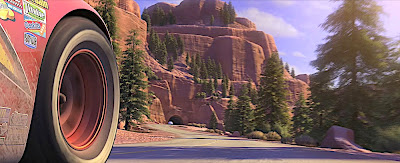
Bill Cone is the production designer who was responsible for creating the look of the film environments and building a road section of 3 km in and out of town Radiator Springs. And we note the following: "For me the style of this film is realistic cartoon. There are cars that talk, and with that we turn away a lot of reality. The forms are a bit extravagant. You can see these types of cars on the rocks, and clouds are stylized. I came to the conclusion that human beings in a human universe would see their own forms in nature, which often happens. Put names to things like Indian Head Rock. So in a world of cars, metaphors would be based on cars. Suddenly, they are rocks that have a car hood. The great American artists as Maynard Dixon also had a great influence on us with their landscapes of the Southwest and painted clouds. "


Sophie Vincelette, supervisor on the film set, was commissioned to create the mountain range of the film paying homage to the famous Cadillacs that dot Route 66. Other mountains are shaped like flying or paracoches.

Undoubtedly, "CARS" represents a new level of attention to detail by Pixar. With its cracked concrete blocks, the accumulated dust and layers of faded advertisements painted on brick walls, Radiator Springs is a place people could visit.


According Vincelette, "Our challenge was to give story buildings. We work closely with teams of models and shading to give the patina that gives over time, and does not seem perfect. The weed grows in sidewalk cracks. "

To add authenticity to the locations of the desert, the department sets modelers had to plant the landscape with thousands of pieces of vegetation, including cactus, sage (brown, green, yellow and ocher) and grass. Rocks were also added many trainings to be more interesting scenarios.


To ensure the authenticity of the car designs, the production design team conducted research in salons car, spent time in Detroit with auto designers and manufacturers, came to racing, and made detailed studies of car materials.

"Research is very important to John," says Pauley. "It was also the most fun part of work because we had to go to all those rooms and car racing, and so on. One of the things did was to visit the workshop Manuel's Body Shop next to the study. He gave us lots of details and helped us understand how to apply layers of paint on a car. "


Thomas Jordan, character shading supervisor, explains: "The chrome and paint the car were our two biggest challenges in this film. We started learning and reading a lot of things. The workshop which was near the study we look at how mixed the paint and how to apply the layers.


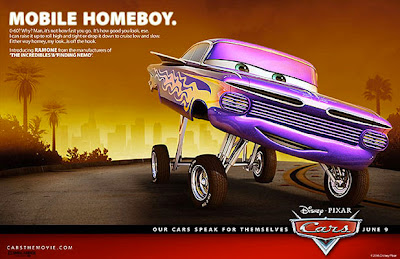
"We try to dissect what happens to the actual painting to recreate in the computer," he continues. He added: "We needed a primer, which is where does the color, and a final layer is what gives the reflection. Then we add things as metal flakes to give a special glow, a glow that changes color pearl depending on the angle, and even "threaded" lines that are hand painted with special brushes on the paintwork, for characters like Ramone. "


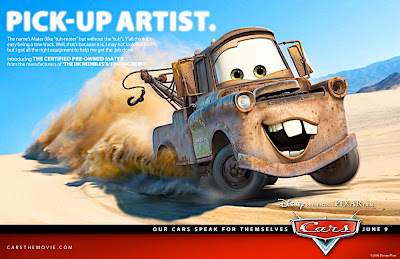
Tia Krater, shading art director, added: "One day while we were in the workshop of Manuel, we found this old paracoches chromium and asked if we could stay with him. He began to clean it but we said, 'No, no, do not clean! " It was exactly what we were looking. We loved how dirty it was and the patina that covered him. He had almost everything we wanted: bites, scratches, stains, rust and dents. All in a paracoches! One of our technicians, who finished shading to Mater, put the sun and spent a lot of time watching and taking pictures to analyze the textures and surfaces. "


Source: Walt Disney Pictures and Pixar Animation Studios